






Application scenarios
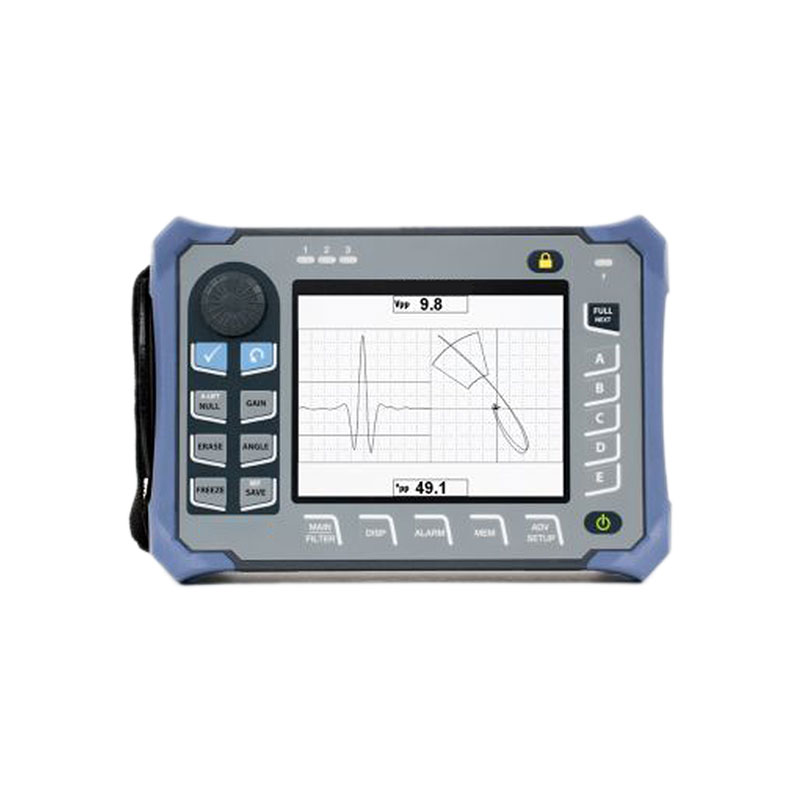
Eddy current flaw detectors are commonly used in military, aviation, railway, and industrial and mining enterprises, and can be used in the field or on-site. They are multifunctional, practical, high-performance, and cost-effective instruments.
Widely used for online and offline flaw detection of various non-ferrous metals, black metal pipes, rods, wires, wires, and profiles. It has high detection sensitivity for defects such as surface cracks, hidden seams, slag inclusions, and open cracks in metal pipes, rods, wires, and profiles.
Reliable performance, sturdy and durable
The casing of the eddy current flaw detector has been verified on site and is very sturdy and durable. It can operate normally in harsh field environments. Due to the durability of the instrument's casing against harsh weather conditions, it can ensure that users can successfully complete eddy current testing work.
Portable and lightweight
The instrument weighs only 1.6 kilograms and is equipped with a wrist strap installed by the manufacturer. The wrist strap helps operators directly use their thumb to control buttons, providing them with the true multifunctional features of handheld instruments.
Key Features
1. Designed to meet IP66 rating standards
2. Compliant with EN-15548 standard
3. Long term battery operation (up to 10 hours)
4. 5.7-inch (14,5 cm) bright VGA display screen
5. Full screen display function can be used in all display modes
6. Improved filter for rotating scanner mode
7. Intuitive interface, providing pre-set options for different applications
8. All settings configuration pages
9. Frequency range from 10 Hz to 12 MHz
10. Automatic internal balancing (BNC interface)
11. Display up to two real-time readings
12. True automatic mixing function
13. Storage capacity for up to 500 files (programs and data)
14. Airborne file preview
Technical Specifications
| Housing | Overall dimensions (width × height × depth) | 236 mm × 167 mm × 70 mm |
| Weight | 1.7 kg, including lithium-ion battery. | |
| Standards or directives | EN-15548, CE, WEEE, FCC (USA), IC (Canada), RoHS (China), RCM (Australia and New Zealand). | |
| Power requirements | AC Mains: 100 VAC to 120 VAC, 200 VAC to 240 VAC, 50 Hz to 60 Hz. | |
| Input and Outputs | One USB 2.0 peripheral port, one standard VGA analog output port, one 15-pin I/O port (male) with 6 analog outputs, 3 alarm outputs. | |
Environmental conditions | Operating temperature | –10 °C to 50 °C |
| Storage temperature | 0°C to 50°C (with batteries) and -20°C to 70°C (without batteries). | |
| IP rating | Designed to meet requirements of IP66. | |
| Battery | Battery type | Single lithium-ion rechargeable battery or optional AA-size alkaline batteries (in 8-cell holder). |
| Battery life | Up to 10 hours for standard operation; 6 hours to 8 hours when operating rotary scanners. | |
| Display | Display size (W × H, diagonal) | 117.4 mm × 88.7 mm, 146.3 mm |
| Display type | Full VGA (640 × 480 pixels) color, transflective LCD (liquid crystal display). | |
| Screen modes | Normal or Full screen, 8 color schemes. | |
| Grids and display tools | Choice of 5 grids; crosshairs (single trace displays only). | |
Connectivity and memory | PC software | NORTEC PC software, included in base NORTEC 600 kit. NORTEC PC allows viewing saved files and printing reports. |
| Data storage | 500 traces of 120 s max featuring user-selectable on-board preview. | |
| Interface | Languages | English, Spanish, French, German, Italian, Japanese, Chinese, Russian, Portuguese, Polish, Dutch, Czech, Hungarian, Swedish, and Norwegian. |
| Applications | Application Selection menu for easy and rapid configuration. Automatic lift-off key. | |
| Real-Time Readings | Choice of up to 2 real-time readings measuring signal characteristics (selection of 5 amplitude measurements and 1 angle measurement). | |
Eddy Current Specifications | Probe types | Absolute and differential in either bridge or reflection configuration. The instrument is fully compatible with NORTEC PowerLink probes, as well as other main probe and accessory suppliers. |
| Probe connectors | 16-pin LEMO and BNC featuring internal automatic balancing for BNC connector (absolute probes). | |
| Frequency range | 10 Hz to 12 MHz | |
| Gain | 0 dB to 100 dB in 0.1 or 1 dB increments. | |
| Rotation | 0° to 359.9° in 0.1° or 1° increments. | |
| Sweep | Variable from 0.005 s to 10 s per division | |
| (total of 13.3 divisions with FINE grid). | ||
| Filters | Low-pass: 10 Hz to 2000 Hz and wide band. High-pass: off or 5 Hz to 1000 Hz, user-selectable in constant “figure 6” or “figure 8” filter type. Continuous null (low-frequency HP filter): 0.2 Hz, 0.5 Hz, 1.0 Hz. | |
| Probe drive | LOW, MEDIUM, and HIGH (2 V, 5 V, 8 V). | |
| Display erase, persistence | Display erase (0.1 s to 60 s), persistence (0.1 s to 10 s) | |
| Available alarm types | 3 simultaneous alarms. Choices include BOX (rectangle), POLAR (circle), SECTOR (pie), SWEEP (time-based), CONDUCTIVITY, and COATING THICKNESS. | |
| Conductivity | Frequency | 60 kHz or 480 kHz |
| Digital conductivity specification | Digital conductivity display from 0.9% to 110% IACS or 0.5 to 64 MS/m. Accuracy within ±0.5% IACS from 0.9% to 65% IACS and within ±1.0% of values over 62%. Meets or exceeds BAC 5651 specifications. | |
| Non-conductive coating thickness | Can measure non-conductive coating thickness from 0 mm to 0.648 mm. Accuracy of 0.025 mm (±0.001 in.) over a 0 mm to 0.64 mm range. | |
| Dual Frequency | Frequency adjustment (dual frequency mode) | Two fully independent frequencies, operating in simultaneous injection. |
| MIX options | F1 - F2, F1 + F2, and automatic true mixing. |